


Courses
23-05-2023


Vote
-
For further training via the Zoom program or at our office? ?
Register a
Violation
We you
Contact youS.O.S.
0032 02 7322568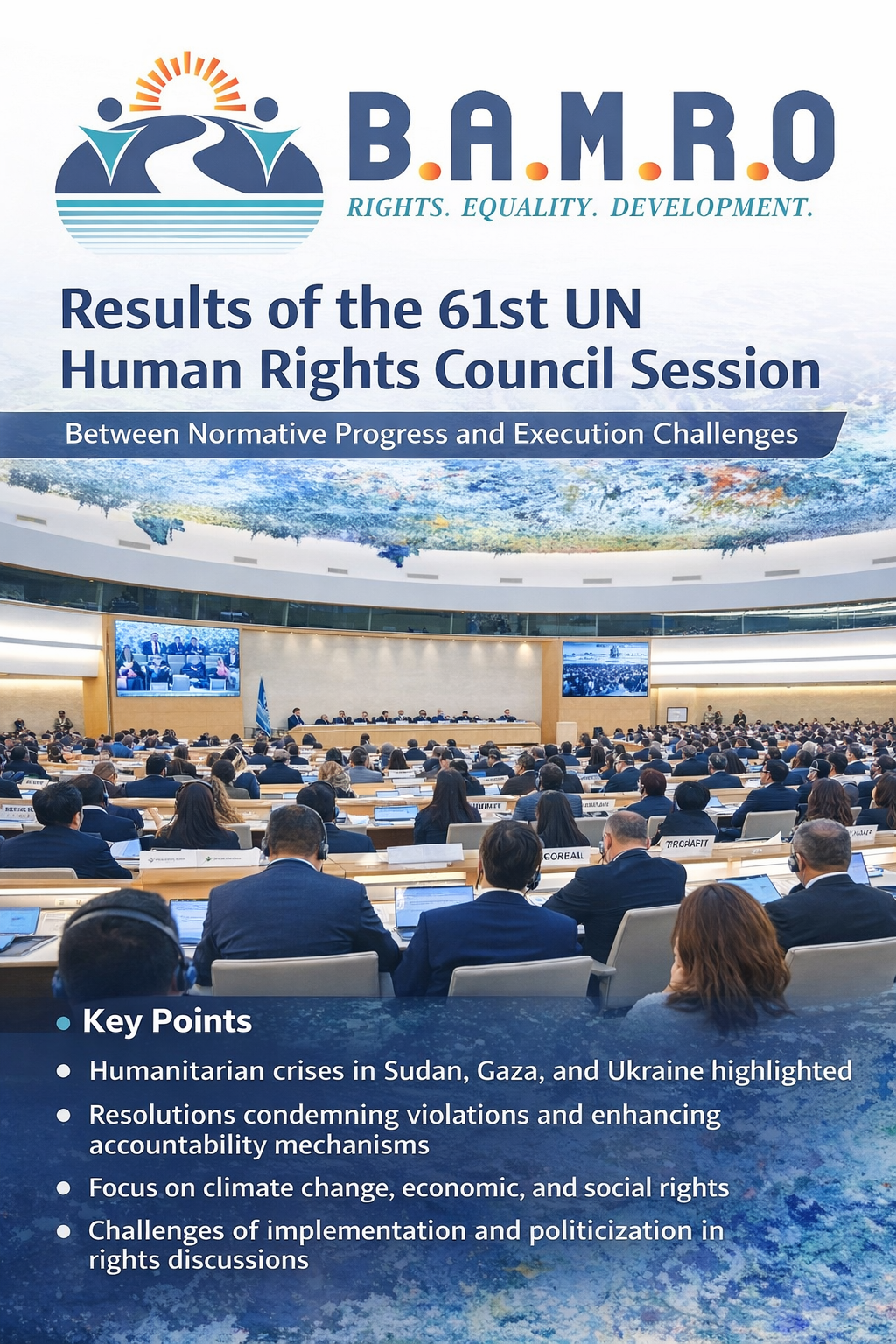
Results of the 61st Session of the UN Human Rights Council: Between Normative Progress and Implementation Challenges
Results of the 61st Session of the UN Human Rights Council: Between Normative Progress and Implementation Challenges
Within the framework of the follow-up carried out by The Belgian Organization for Human Rights and Development to the work of the United Nations Human Rights Council, and in line with its commitment to monitoring international human rights developments, the organization reviews the outcomes of the 61st session, based on its role as an ECOSOC-accredited NGO.
With the conclusion of the 61st session of the United Nations Human Rights Council, the attention of the international community turns once again to assessing the progress made in addressing global human rights issues and evaluating the effectiveness of the international system in responding to escalating crises.
I. General Context of the Session
The 61st session was held amid an unprecedented escalation of humanitarian crises, with several key issues highlighted:
- The crisis in Sudan
- The ongoing conflict in Gaza
- The war in Ukraine
- Increasing challenges related to migration and displacement
This session reflected growing pressure on human rights mechanisms in light of expanding violations and increasingly complex political contexts.
II. Key Outcomes
1. Resolutions and Condemnations
The session resulted in the adoption of several resolutions condemning serious violations and calling for:
- The cessation of hostilities against civilians
- Respect for international humanitarian law
- Unhindered access to humanitarian aid
It also reaffirmed the principle of accountability and the fight against impunity as a cornerstone of any sustainable resolution.
2. Strengthening Monitoring Mechanisms
The session supported the expansion of mandates for investigative bodies and fact-finding missions, particularly in conflict zones, to:
- Professionally document violations
- Preserve evidence for future accountability
- Support transitional justice efforts
3. Focus on Major Humanitarian Crises
The crisis in Sudan emerged as one of the most critical issues discussed, highlighting:
- Widespread violations against civilians
- Massive displacement affecting millions
- The risk of famine in several regions
Other complex human rights situations were also addressed, reflecting the widening gap between international commitments and on-the-ground realities.
4. Emerging Issues: Climate and Economic Rights
The session emphasized the interconnection between:
- Climate change
- Economic and social rights
- The right to development
Environmental crises were recognized as direct threats to human rights, particularly in fragile contexts.
III. Key Challenges
Despite normative progress, several challenges were identified:
- Weak implementation mechanisms
- Politicization of human rights discussions
- Limited impact of resolutions without genuine political will
- Continued violations despite documentation and condemnation
This raises a fundamental question:
Does the international human rights system possess effective tools for change, or does it remain primarily normative?
IV. Analytical Reading
The 61st session revealed a clear paradox:
- Progress in human rights standards
- Persistence of violations
This indicates that the real challenge lies not in identifying problems, but in ensuring implementation and accountability.
V. Recommendations
- Strengthening international accountability mechanisms
- Supporting the independence of investigative bodies
- Ensuring effective implementation of resolutions
- Empowering civil society in conflict areas
- Linking international aid to human rights compliance
Conclusion
The outcomes of the 61st session of the United Nations Human Rights Council confirm that the international system continues to produce standards, yet faces serious challenges in translating them into tangible realities.
Listings
- 1
- 2
- 3
- 4
- 5
