


Courses
23-05-2023


Vote
-
For further training via the Zoom program or at our office? ?
Register a
Violation
We you
Contact youS.O.S.
0032 02 7322568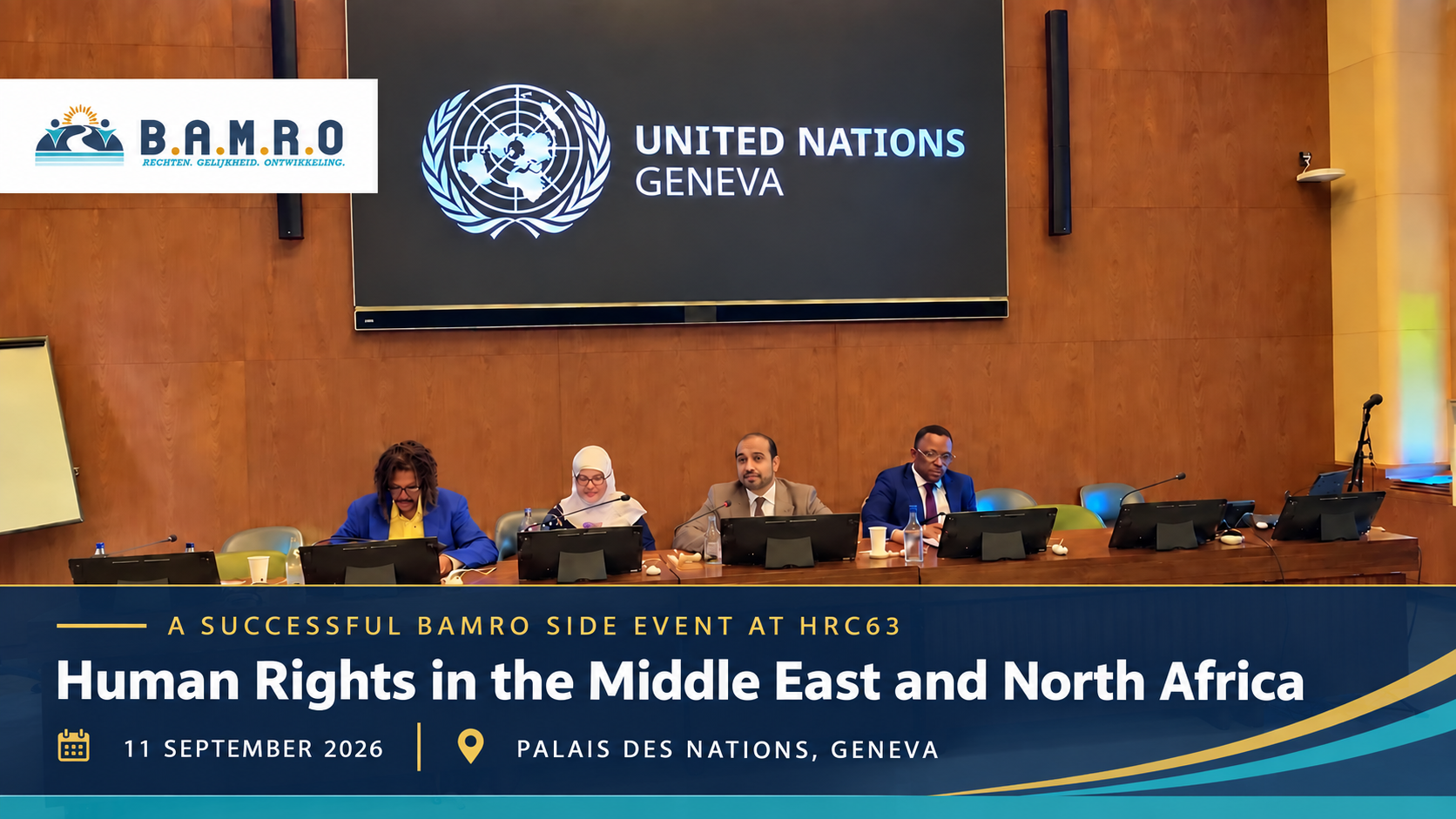
Success of our seminar at the Human Rights Council… and special thanks to the Permanent Mission of Belgium to the United Nations in Geneva
Success of our seminar at the Human Rights Council… and special thanks to the Permanent Mission of Belgium to the United Nations in Geneva
Geneva – September 11, 2026
The Belgian International Organization for Human Rights and Development (BAMRO) achieved a significant success in organizing its side event officially titled "Human Rights in the Middle East and North Africa," held on Friday, September 11, 2026, in Room XI of the Palais des Nations in Geneva, on the sidelines of the 63rd session of the United Nations Human Rights Council.
The event was listed in the official program of side events under the organizing entity's name "Brussels For Human Rights And Development," and coincided with the Council's 63rd session, running from September 7 to October 7, 2026.
A valued diplomatic and human rights presence
The seminar brought together representatives of international diplomatic missions, alongside human rights defenders, experts, and civil society representatives. The organization expresses its pride and particular appreciation for the presence of a representative from the Permanent Mission of Belgium to the United Nations in Geneva.
The Belgian mission's presence and its attentiveness to the testimonies and issues presented constitute important support for the space of human rights dialogue, and affirm the importance of keeping victims' cases — particularly those of women, children, victims of conflict, and enforced disappearance — before international institutions.
The organization extends its thanks to Belgian institutions and to the Permanent Mission of Belgium in Geneva for their attention to these issues. This presence is consistent with Belgium's stated policy of supporting active multilateralism, promoting human rights, protecting children in armed conflict, and combating impunity.
The organization also affirms its appreciation for the presence of other international missions, as the participation of diplomatic representations in such gatherings allows for direct listening to victims and human rights defenders, and supports the inclusion of their cases within international dialogue and accountability and follow-up mechanisms.
Direct testimony from families of victims of enforced disappearance
One of the seminar's key moments was a direct testimony delivered by a family member of victims of enforced disappearance. This testimony marked an important precedent within the organization's activities at the Human Rights Council, carrying the suffering of families beyond written reports and abstract figures into a direct human voice heard by those present inside the Palais des Nations.
The testimony affirmed that enforced disappearance violates not only the rights of the victim but places the entire family in a continuous state of waiting, anxiety, and absence of truth. It also reaffirmed families' rights to know the fate of their loved ones, to access justice, to obtain effective reparation, to hold those responsible accountable, and to ensure non-recurrence of violations.
Sudan, Darfur, Eritrea, and Iraq
Speakers' remarks addressed the human rights situation in Sudan, particularly in the Darfur region, and the risks faced by civilians as a result of conflict, violence, displacement, and obstructed access to justice and protection.
The seminar also addressed cases of enforced disappearance, arbitrary detention, and restrictions on rights and freedoms in Eritrea, and their serious effects on victims and their families.
On the Iraqi file, speakers discussed the challenges related to protecting civilians, women, and children, the rights of families of the missing and disappeared, and the need for institutions capable of conducting independent investigations, providing remedies, and translating legal texts into real protection in citizens' lives.
The interventions stressed that the protection of human rights is not achieved merely by acceding to international conventions or enshrining rights in constitutions, but requires practical implementation, independent institutions, and accountability mechanisms accessible to victims without discrimination or fear.
Dr. Abdelsamad Mekhlouf: Five pathways to closing the gap between law and its application
The President of the Belgian International Organization for Human Rights and Development, Dr. Abdelsamad Mekhlouf, stated that one of the most prominent challenges in the Middle East and Africa is the widening gap between declared legal norms and their actual implementation.
He explained that the existence of constitutions, laws, and ratification of international conventions are necessary steps, but they are not sufficient if institutions remain unable to implement them, if the judiciary lacks independence, authority, and resources, or if the law is applied selectively or discriminatorily.
Dr. Abdelsamad identified five essential pathways to closing this gap:
- Aligning national legislation with international law: Reviewing domestic laws to ensure their consistency with international human rights conventions and the obligations states have accepted.
- Supporting judicial independence and effectiveness: Building genuinely independent judicial institutions equipped with the legal authority and the human and material resources needed to investigate, adjudicate, and provide redress to victims.
- Strengthening implementation and oversight institutions: Enabling national and oversight bodies to monitor the implementation of laws and decisions, and ensuring legal texts are not left without clear, measurable mechanisms.
- Ensuring equality, non-discrimination, and access to justice: Applying the law to everyone without discrimination based on sex, origin, religion, or political or social affiliation, and guaranteeing effective remedies for victims — particularly women, children, and groups most vulnerable to violations.
- Systematic follow-up on UN recommendations: Developing national plans to implement the recommendations of UN mechanisms, foremost among them the Universal Periodic Review (UPR), alongside recommendations from treaty bodies and special procedures, with designated responsible parties, timelines, and implementation indicators.
The organization's president affirmed that the value of international recommendations is measured by their ability to bring about real change in victims' lives, and that cooperation between governments, the judiciary, national institutions, civil society, and diplomatic missions is essential to translating legal commitments into tangible protection.
Thanks and commitment to continued work
The organization renews its special thanks to the Permanent Mission of Belgium to the United Nations in Geneva, and to all international missions, experts, speakers, and human rights defenders who participated in the seminar and contributed to its success.
The organization will continue its work of conveying the voices of victims and their families, defending the rights of women and children, following up on cases of enforced disappearance and violations occurring in conflict areas, and advocating for judicial independence, the rule of law, and accountability for perpetrators of violations without discrimination.
Institutional note: This seminar was held as a side event organized by the organization within the Palais des Nations, on the sidelines of the 63rd session. Side events provide a space for dialogue and advocacy, but do not constitute official sessions of the Council, and their deliberations do not represent decisions issued by the United Nations. The presence of any diplomatic mission reflects interest, attentiveness, and participation in dialogue, and does not necessarily imply endorsement of all views expressed by the speakers.
Listings
- 1
- 2
- 3
- 4
- 5
